

Understanding Radiation and Natural Gas Development
How is radiation associated with gas operations?
Much of the petroleum and natural gas developed in the United States was created by the decay of ancient sea life. Naturally occurring radionuclides, which are radioactive forms of elements, and their decay products are found in various natural formations, including shale rock and gas formations, because of the origin of these sedimentary rocks and their organic content. Gas reservoirs often contain detectable amounts of radionuclides like radium-226, radium-228, and lead-210, which occur naturally in the earth. These constituents, collectively known as Naturally Occurring Radioactive Material (NORM), can become what is referred to as Technologically Enhanced (TENORM) through human activities such as oil and gas production, mining, and water treatment.

Did You Know?
Every day, cosmic rays from the sun and distant stars pass through our atmosphere, contributing about 20-30 millirem a year to the average American’s radiation dose.
Where can TENORM appear in gas operation activities?
Drilling Waste
Drill cuttings from formations with elevated radioactivity have the potential to convey TENORM back to the surface.
Produced Water
Heavy Brine (or saltwater) separated from the hydrocarbons contains dissolved radionuclides.
Scale and Sludge
Deposits of radium can accumulate forming detectable levels inside pipe, tanks, and equipment when produced water flows from the well through the system.
What is the typical radiation dose from exposure to typical NORM and TENORM sources?
0.07 mrem
0.006 mrem
0.002 mrem
1 mrem
1 mrem
0.008 mrem
100 mrem
40 mrem
0.03 mrem
Radiation Dose Comparisons
When considering radiation doses from oil and gas operations, we can use the Technologically Enhanced Naturally Occurring Radioactive Materials (TENORM) Study by the PA Department of Environmental Protection to compare to other real-world doses, assuming workers are present during drilling, fracturing, and production phases of operations and are exposed to drill cuttings, hydraulic fracturing fluid, flowback water, and produced water.

The graphic above provides a summary of estimates of the radiation dose associated with various activities. In any given setting, the actual doses are expected to vary somewhat from the estimates provided. Even so, we can assume that the annual radiation dose resulting from driving a shale oil and gas wastewater truck is likely to be less than 1 mrem, or less than one-tenth of the dose from a single abdomen x-ray. Similarly, the annual radiation exposure to workers at a shale oil and gas well site is expected to be less than 30 mrem, or about one-quarter of the expected annual dose experienced by a resident of Albuquerque.
What does CNX do to monitor and mitigate radiation risks?
CNX’s best-practice approach includes:
Conducting routine radiation surveys of equipment, waste streams, and work areas using dose-rate and contamination meters.
Training workers on radiation hazards, ALARA principles, safe work practices, and “stop work” authority.
Classifying, handling, and disposing of NORM/TENORM containing waste at appropriately permitted facilities under state and EPA regulations.
Maintaining records, reporting any exceedances to regulators, and periodically auditing the program for continuous improvement.
CNX is committed to disclosing the findings associated with the monitoring we conduct as part of our overarching CRPP. We will disclose these findings and any actions that may result from encountering any unanticipated TENORM levels associated with our operations.
Read CNX’s Comprehensive Radiation Protection Plan Annual Self-Assessment
Radiation Monitoring
 CNX has committed to strongly enhancing our Radical Transparency program by initiating ambient gamma radiation and vehicle gamma radiation monitoring programs. All site-specific radiation monitoring data is coordinated by and reviewed for quality assurance by an accredited third party, Onterris, a global environmental solutions company. Onterris’s monitoring plans are informed by decades of expertise in the design and implementation of continuous monitoring and radiological safety programs that deliver accurate, credible, field-based data.
Ambient Gamma Radiation Monitoring
Vehicle Gamma Radiation Portal Monitoring
Quality Assurance Project Plan
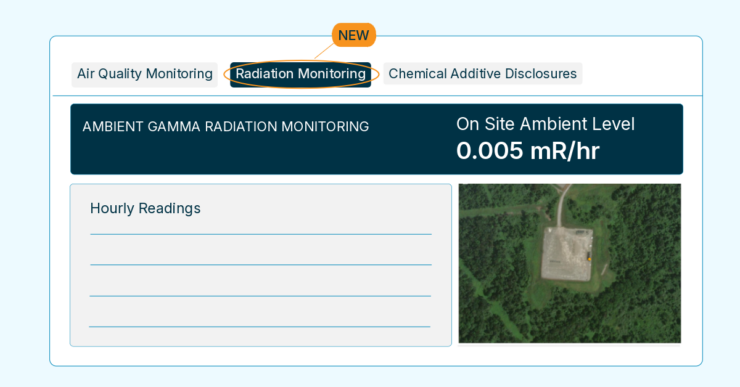 Radical Transparency Expands to Radiation Monitoring and Disclosure
 When the Atmosphere Has a Lid: Heat Domes and PM2.5
 Water Supply Concerns: A Look at Response and Resolution